

ISO 27001: An Introduction
ISO stands for the International Organisation for Standardisation, and the ISO 27001 is simply a non-mandatory standard set for the establishment, implementation, maintenance, and continuous improvement of information security systems. These standards are for any organisation, regardless of size or type.
Companies can choose to implement any such means to clarify that they are in line with the best industry-wide practices. An ISO 27001 certification has innumerable benefits for any organisation, some of which are outlined here.
ISO 27001 makes use of a top down, risk-based approach while remaining technology neutral. The specification stands out from other security management systems of its kind because it is not the sole responsibility of the IT department alone, rather the management of all sensitive information has various checks across all departments.
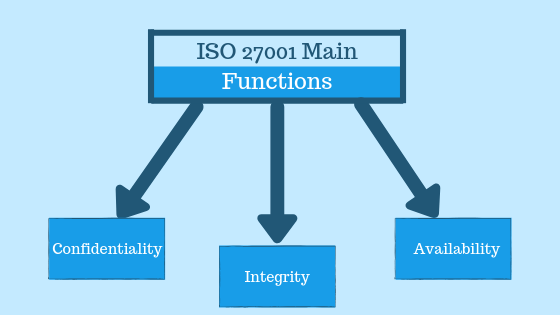
An ISO certification is not merely present to manage your information security. It manages to maintain confidentiality of client/ employee information. It also ensures that information is both accurate as well as complete. Similarly, any safeguarded data is still easily accessible for any authorised personnel. All of these functions are outlined in this image.
ISO 27001’s Objectives
The set of comprehensive security control objectives are mentioned in the 12 main sections of the ISO 27001. These include:
- Risk Assessment
- Security Policy
- Organisation of Information Security
- Asset management
- Human Resources Security
- Physical and Environmental Security
- Communications and Operations Management
- Access Control
- Information Systems Acquisition, Development, and Maintenance
- Information Security Incident Management
- Business Continuity Management
- Compliance

Stages of Achieving an ISO certification
Some of the stages that you need to go through to thoroughly protect your business and achieve an ISO 27001 certification includes:
- Assessing potential risks to your business and identifying areas of vulnerability
- Implementation of a management system that encompasses the entire organisation and helps control where information is stored and how it is used
- Maintenance of processes that manage both the current and future information security policy.
- Informing both employees and contractors about risks and incident reporting
- Monitoring all system activity and logging user activities
- Keeping IT systems updated with the latest protective measures
- Establishing System Access Control
Prudential Solutions will be conducting an ISO training workshop soon. Register yourself now to improve your organisational security and framework. For any further queries, contact us at trainings@www.prudsol.com